
Planning, calculations & simulations
Good acoustic design often starts with calculations or simulations to predict how a system will behave.

Outdoor sound propagation in accordance with ISO 9613-2
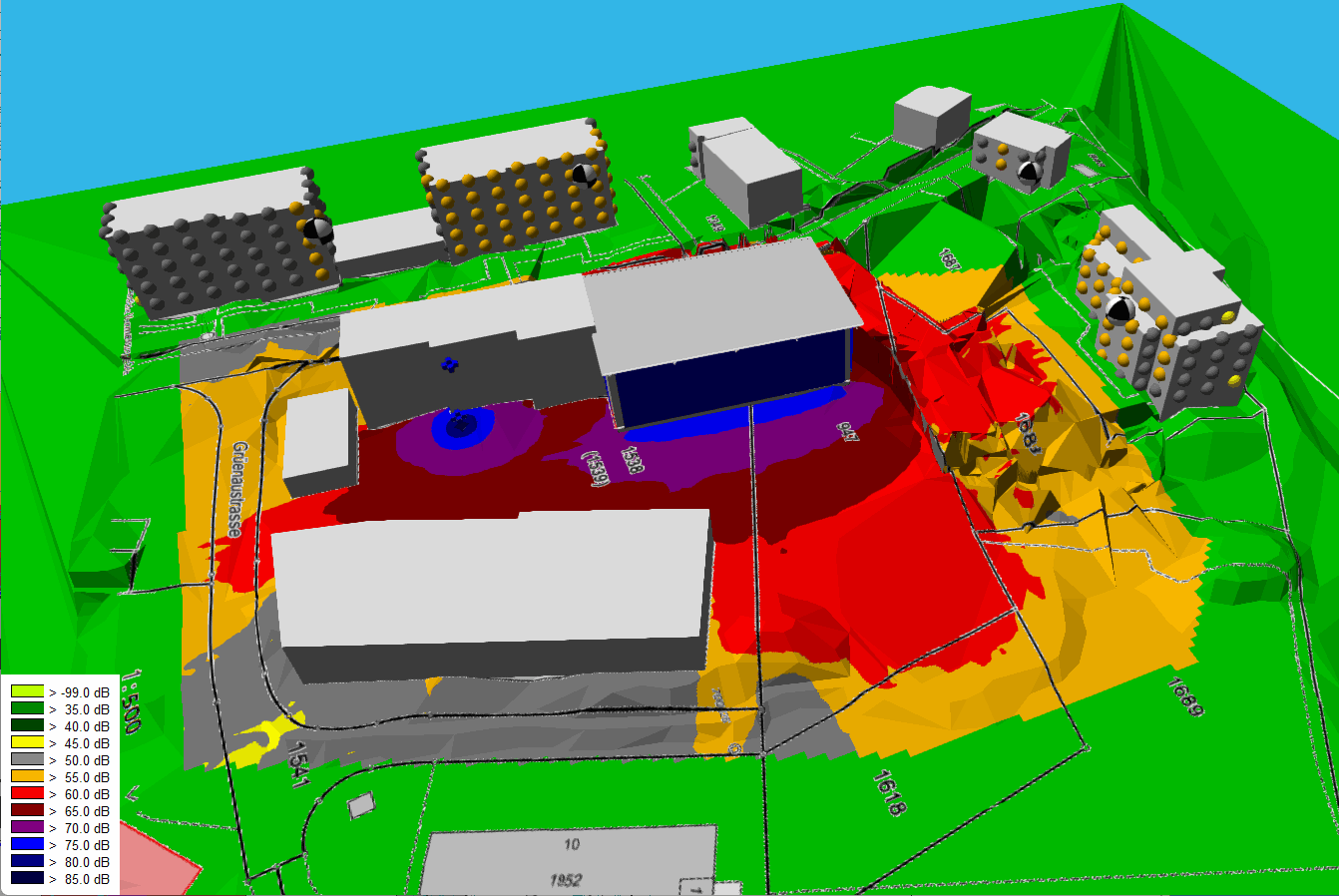
Calculation of sound propagation outdoors over longer distances, accounting for obstacles, ground conditions and atmospheric effects. The simple divergence formula (distance law) used in many compliance forms is insufficiently accurate under the following conditions:
- a reflected sound path in addition to the direct path
- an obstacle in the propagation path
- distances exceeding 50 m
We use the standardised method — attenuation of sound during propagation outdoors, Part 2 (ISO 9613-2).
Room acoustics
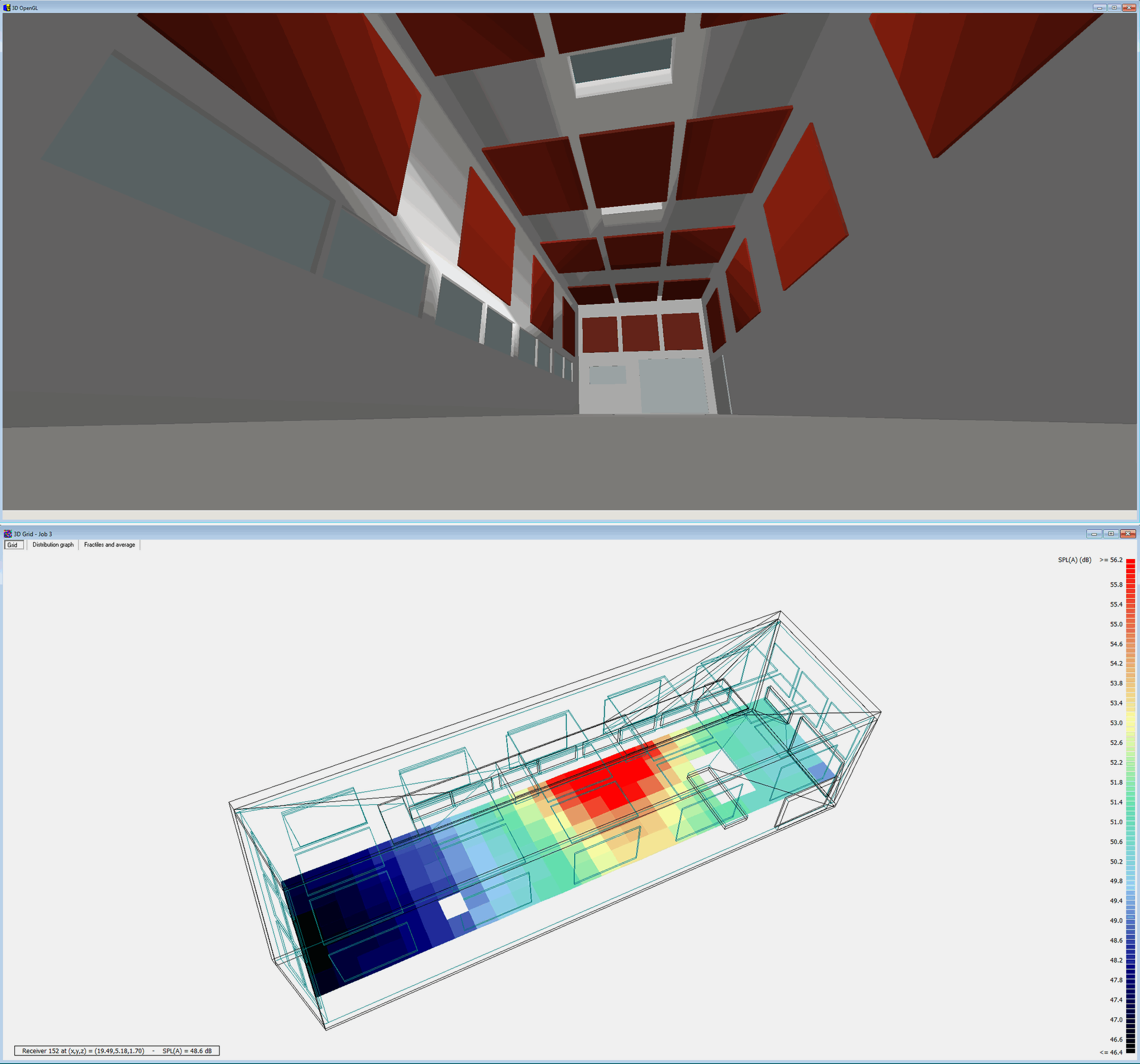
Simulation of sound propagation in rooms using Odeon — ray tracing combined with frequency-dependent scattering at reflecting surfaces. Calculated quantities include:
- path attenuation
- level distribution
- speech intelligibility
- reverberation time
- various other parameters
Silencers
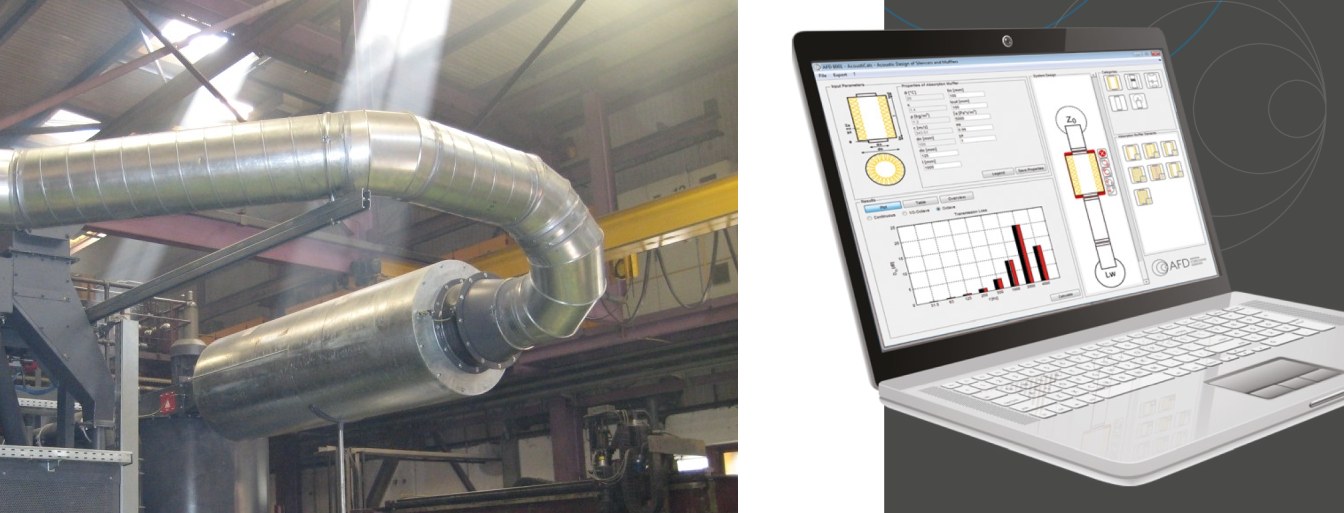
Simulation of silencers using AcoustiCalc Silencer AED 8001. The individual segments of the sound path are modelled with four-pole parameters to accurately account for sound power. Silencer types we can model include:
- absorptive silencers (tubular and splitter silencers)
- reactive silencers
- resonator silencers
Further parameters: pressure drop and self-generated noise.
Vibration isolation
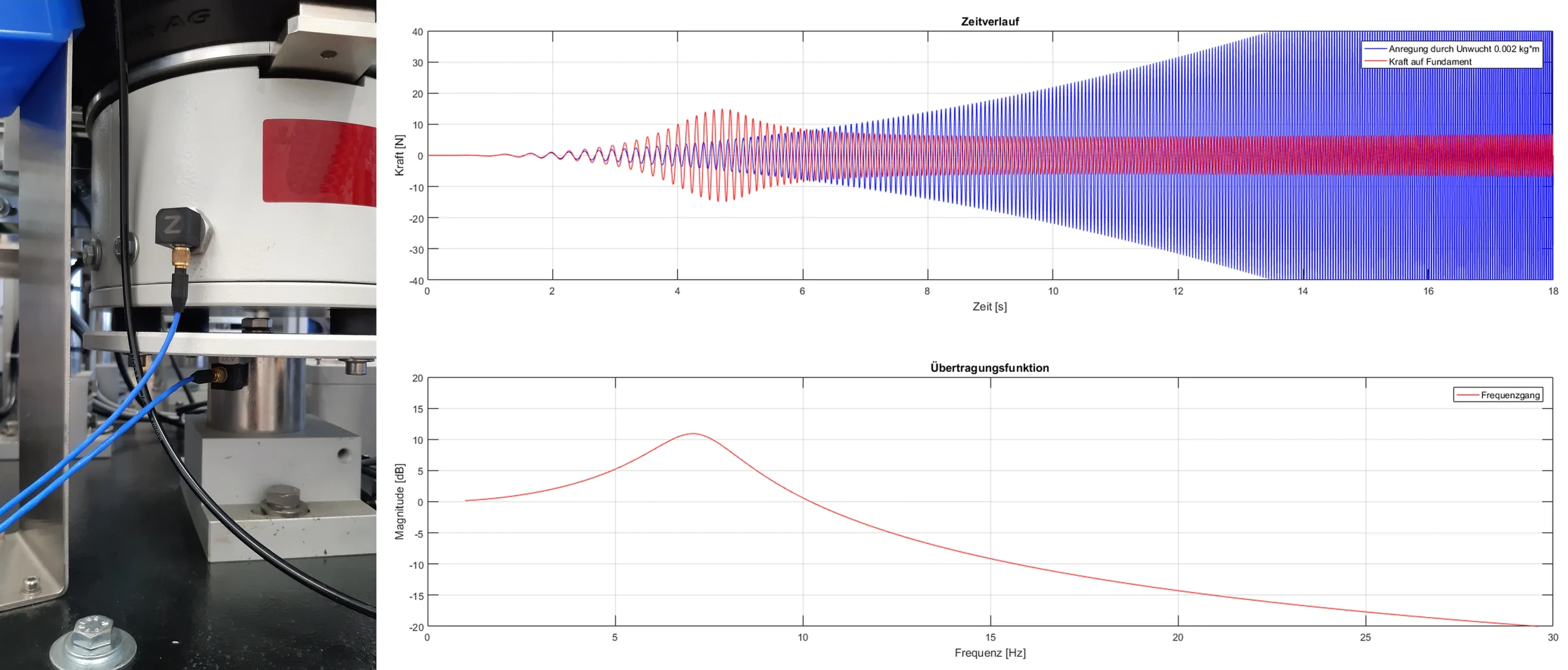
Simulation and calculation of the effectiveness of vibration isolation measures. The mechanical system is represented by spring-mass-damper models and transmissibility is calculated over the relevant frequency range.
Parameters that can be determined: transmissibility, natural frequency of the isolated system, isolation effectiveness in dB per frequency band, and sizing of spring and damping elements.
Loudspeakers / transducers
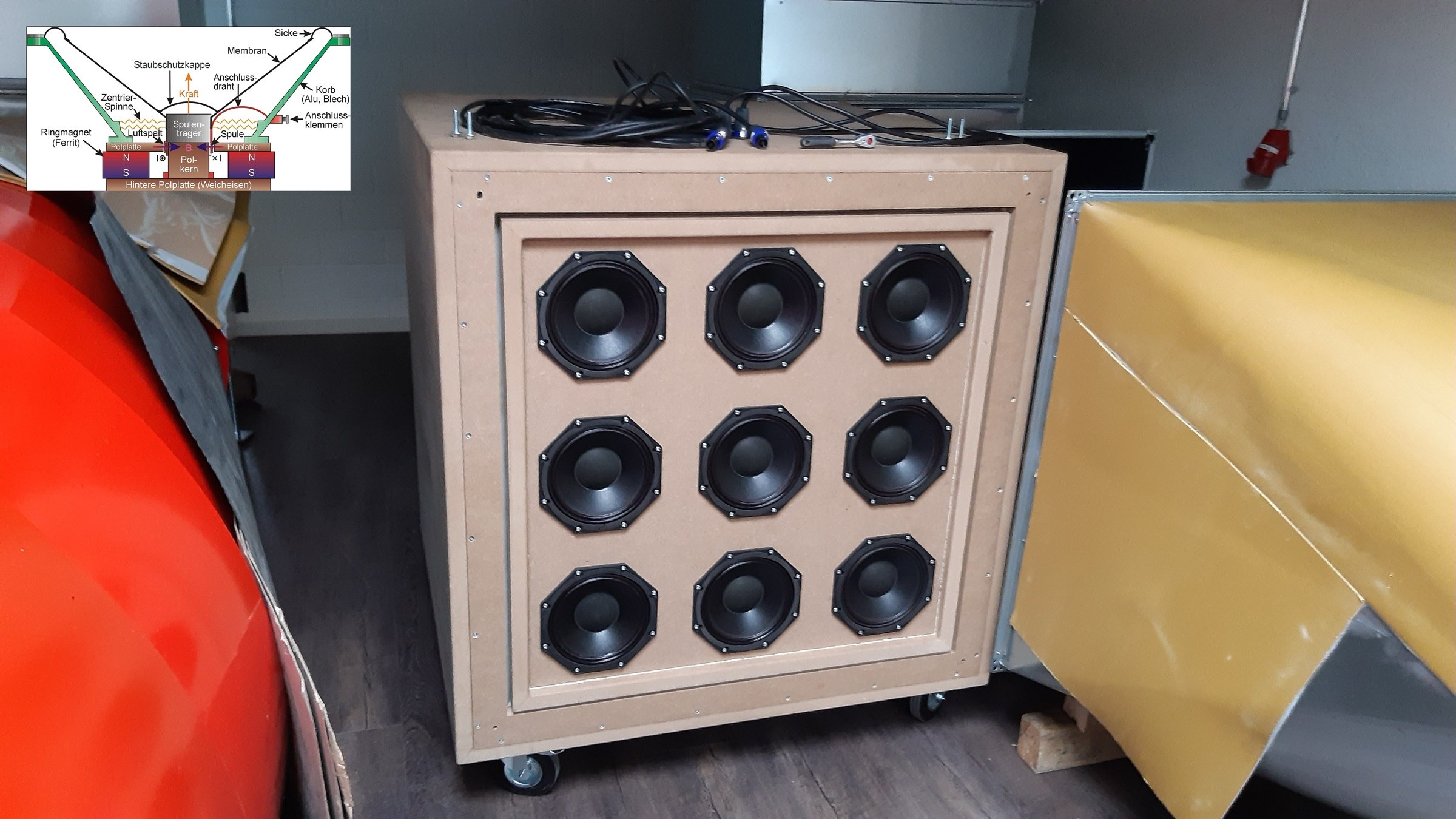
Simulation of loudspeakers using our own MATLAB programs. The electromagnetic, mechanical and acoustic systems are modelled with four-pole parameters to consistently account for energy across all three systems.
Parameters that can be calculated:
- efficiency
- transfer function
- input and output impedance
- tuning frequency
- other parameters can be added as required.