
Long-term noise monitoring
A site visit captures only the period when the engineer is taking measurements. Intermittent noise may not occur during that time, making it impossible to locate or assess. Long-term monitoring runs continuously, capturing sounds that a short visit might miss.

Why measurements run for days
A standalone instrument measures continuously from a fixed position in the room where the noise is heard. The person affected keeps a noise diary, which we later compare with the measurement data.
The measurement records when a disturbance starts, when it ends and the pattern in which it recurs. That is often half the diagnosis: an hourly pattern suggests a constant-setpoint controller, a weekly pattern an industrial operating cycle, and a pattern correlated with outdoor temperature points to a heating system as the cause.
The measurement system
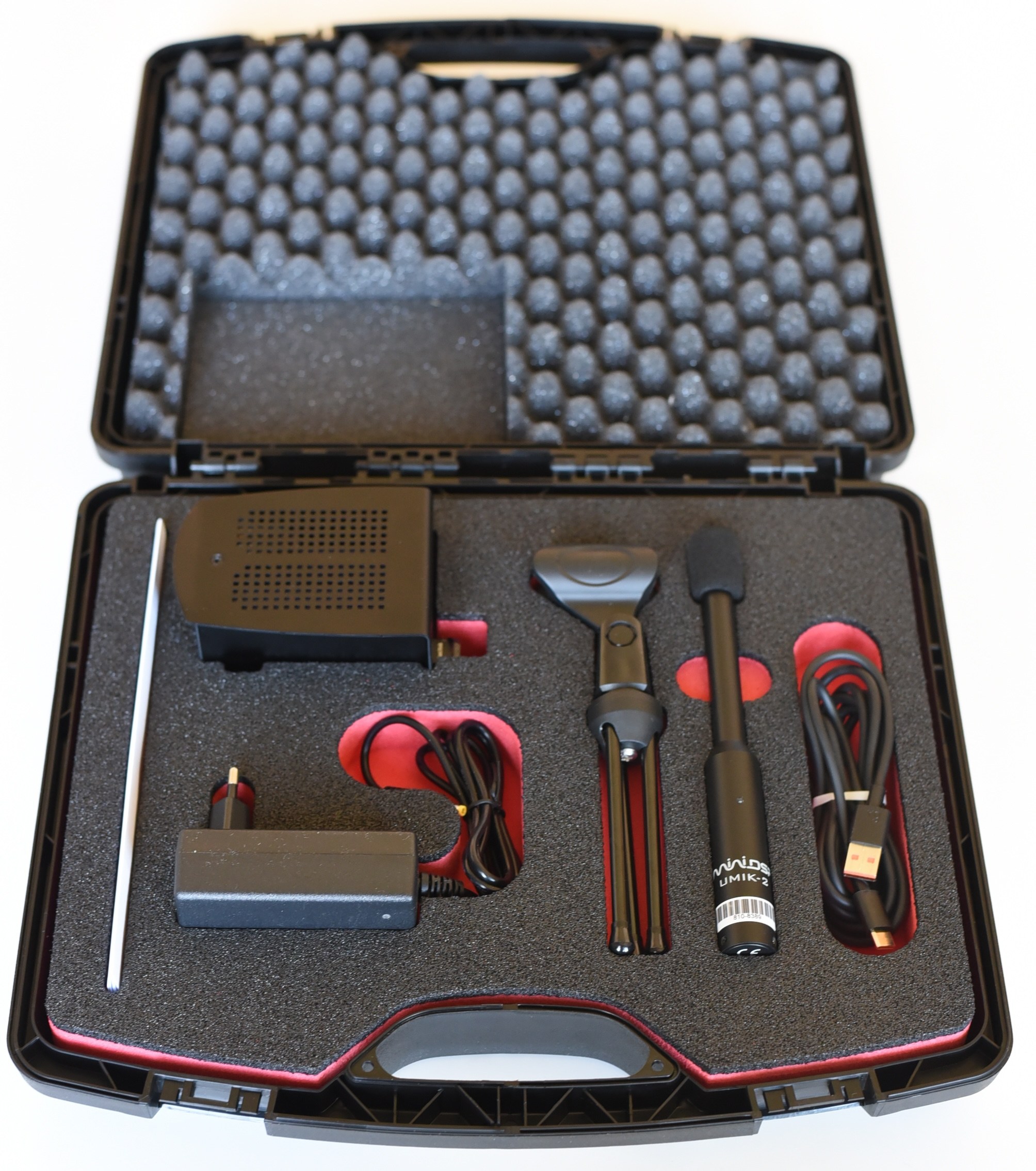
Compact, with no complex setup, and designed for long, unattended measurements:
- Microphone: low self-noise (16.5 dBA), calibrated to 0.1 dB, frequency range 12.5 Hz to 20 kHz — optionally from 3 Hz on request.
- Frequency resolution: up to 96 bands per octave — fine enough for narrowband tonal components and slow frequency changes
- Time base: temperature-compensated clock
- Backup battery: continues measuring for up to 4 h during a power failure
- Data: stored locally on the instrument during the measurement campaign
- Wireless: Wi-Fi and BLE are permanently disabled
No speech content is recorded; no playable speech recordings or recordings of private conversations are produced.
We program the instruments and analysis server ourselves. Settings required for your problem, such as resolution, measured quantities or analyses, can be selected easily in the web tool instead of having to be chosen in advance from an instrument menu.
Monitoring for industry and construction
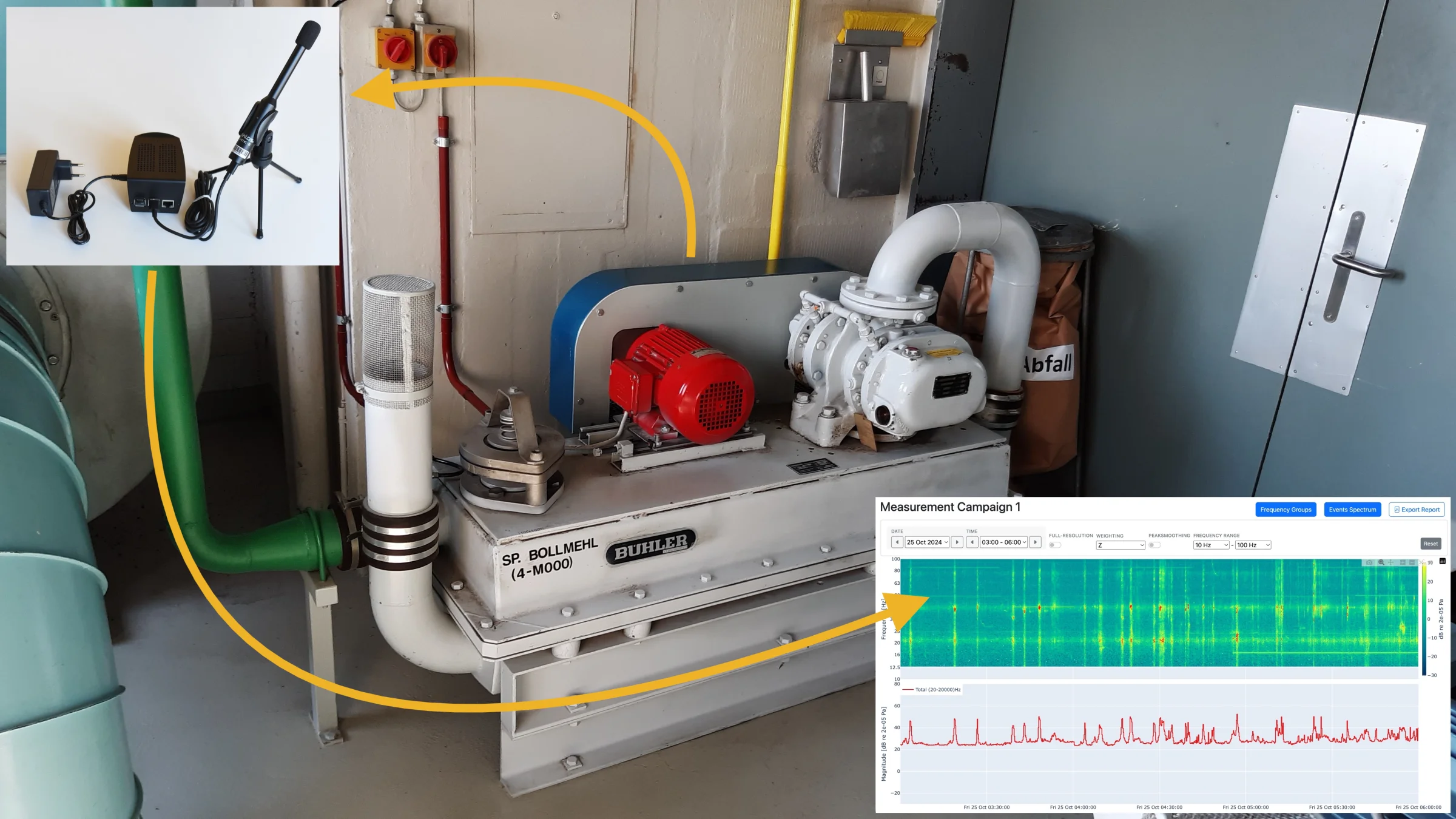
The technology can be used for a single campaign or installed permanently — for continuous or periodic operation:
- Data acquisition: autonomous instruments or permanently installed sensors
- Data transmission: local storage or a direct server connection
- Visualisation: web dashboard with trend analysis, spectrogram and alarm functions
- Analysis: automated detection of anomalies and critical conditions
Sound and vibration signals reveal a machine's condition long before a defect becomes visible; in construction, concurrent monitoring demonstrates that commitments were met during the works.
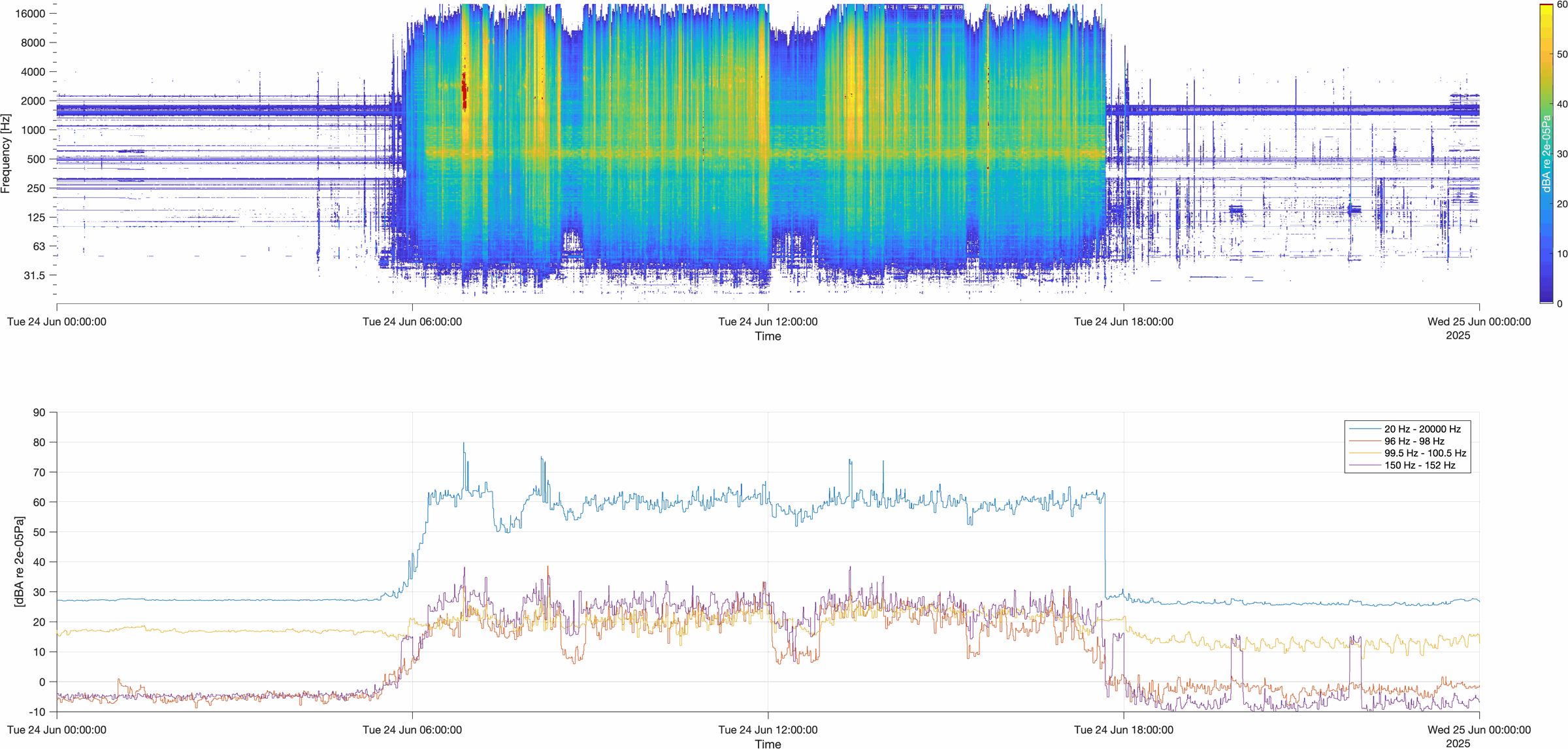
The two traces below come from a measurement one of our instruments is running right now. Each shows the level in a narrow frequency band — exactly where a single hum sits. That is what separates monitoring from a level recorder: what you see is not how loud it is overall, but when this one source is running.
In a scope like this one — or in a fuller dashboard we develop for the specific application — we can plot any acoustic quantity that matters for your case alongside any other measured value: temperature, humidity, further weather or sensor data. The web app puts them on the same time axis, so a level trace can be compared directly with the operating or weather conditions.
Sonotrazer — noise monitoring for your home
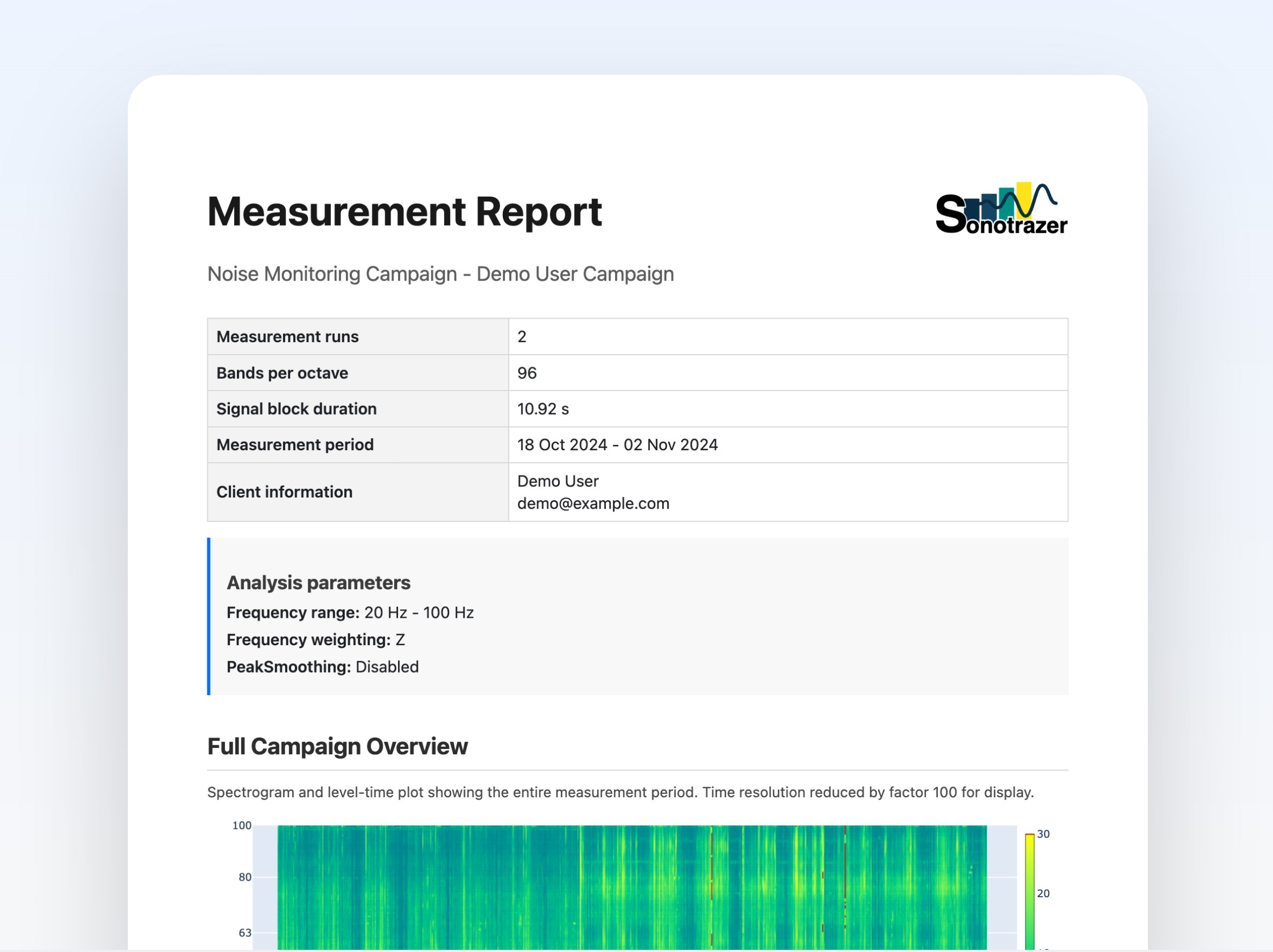
For households, we offer a complete noise-monitoring service. We post the measurement kit to you. Place it where the noise is most noticeable and leave it running for up to two weeks. A prepaid return label is included.
You can review the data in your browser: examine sounds of interest, events you have marked and recurring patterns, and listen to an audio representation of selected moments. A Sonotronex acoustics engineer reviews the data with you, identifies the most likely source category and recommends the next step. The PDF report summarises what you want to demonstrate to your landlord, property manager, installer or neighbours.
We calibrate the instrument before every shipment. The measurement is precise and informative, but does not replace a formal expert report for legal purposes.
Long-term measurement is a suitable preliminary investigation when a disturbance occurs irregularly or mainly at night. It shows whether and when a recurring pattern exists and whether a targeted on-site investigation is worthwhile. If the noise is reliably present during certain periods, a direct on-site visit is generally the faster approach.
For property managers and authorities
For a noise complaint, a measurement campaign first establishes whether recurring sounds are present and what next step is justified:
- A recurring pattern is documented and a more detailed investigation is justified.
- A recurring disturbance is present, but the levels are too low to establish a legal need for action. The next step may be a technical investigation or an agreement.
- No disturbing sounds are identified during the campaign — no immediate next steps are indicated.