
Active noise control systems
The idea is elegant: a second, appropriately controlled sound field attenuates the disturbing sound. The method is called active noise control; in everyday speech, anti-noise or active noise cancellation. For suitable low-frequency noise, this can work without the mass and installation space required by passive insulation or enclosure. We test whether it works where it matters by testing it on the equipment itself.

When ANC is the right solution
ANC is particularly promising for low-frequency, tonal or periodic noise when the geometry, operating condition and areas to be protected are clearly defined. It is of particular interest where mass, installation space, airflow or pressure loss limits conventional measures.
The usable upper frequency limit depends on the dimensions of the source and the sound paths. In many applications it is below 200 Hz; with dimensions or path lengths over one metre, it is often below 100 Hz. These are guide values, not fixed limits — the specific geometry determines the limit.
ANC headphones control a very small, fixed sound field immediately at the ear. That result cannot simply be scaled up to a room or machine: the source, propagation paths and target positions must all form part of the design.
Typical candidates for testing include:
- variable-speed compressors, refrigeration plant and heat pumps
- fans and blowers
- supply-air, extract-air, exhaust and intake ducts
- transformers
- vibrating screens, troughs and bowls, and vibratory conveyors
Inclusion in this list is not a guarantee of suitability — every new application must be measured and tested. Conventional measures are generally more economical for broadband, highly variable, whistling or hissing noise.
Field measurement example: heat pump
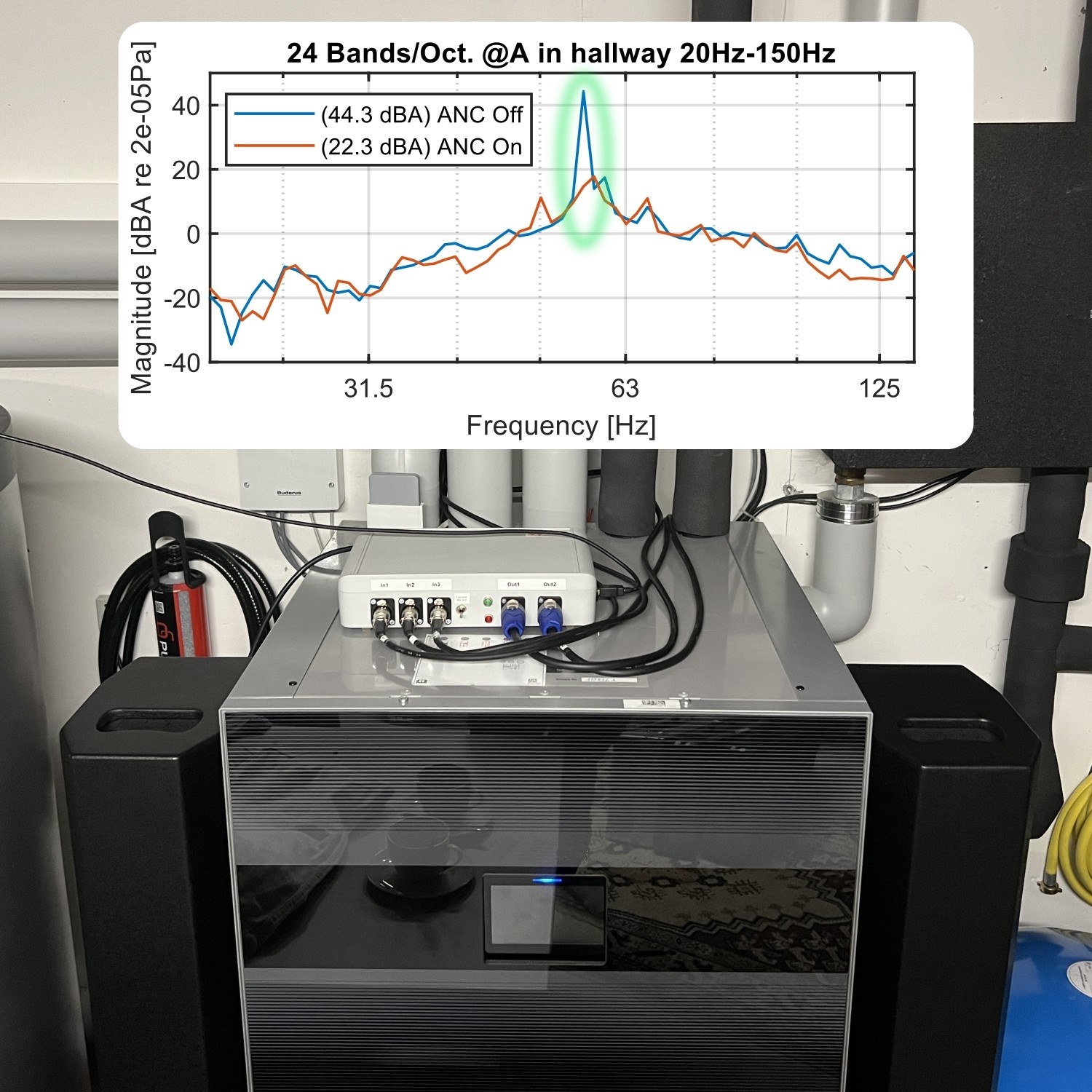
The image shows an ANC system implemented by Sonotronex on the indoor unit of a heat pump. A pronounced compressor tone around 55 Hz was audible from the basement to the home office. The compact controller, measurement microphones and two matched loudspeakers specifically reduce this dominant component. The system has operated in the field for more than a year.
The curves compare the same operating condition with ANC off and on; they show A-weighted levels in 24 bands per octave. The legend values are the energy-summed A-weighted levels over the displayed range from 20 to 150 Hz. This value fell from 44.3 to 22.3 dB(A). The measurement point shown was in the corridor, far from the machine. Reduction of the dominant component was also measurable at other positions remote from the machine.
This is a controlled technical on/off comparison under the conditions of this installation, not a standards-compliant assessment or a general performance guarantee for other plant.
ANC test on actual equipment
Our first conversation establishes whether ANC could suit your application. If the approach looks promising, we offer a clearly scoped, paid ANC feasibility test on your equipment or prototype. We use a very-low-latency, multichannel Speedgoat development computer, calibrated measurement microphones and, depending on the task, general-purpose or custom-built loudspeakers as secondary sources.
We measure each relevant operating condition both without and with active control. The test provides:
- a measurement-based go/no-go decision
- an ANC on/off comparison at agreed measurement points
- if the result is positive, a concept for the controller, sensors, secondary sources and integration
- clear documentation of the methods and results, supplemented where useful by standardised measurements and a corresponding report
From test to system
A successful trial provides the basis for the operational system. The control, sensors and secondary sources are matched to the geometry, spectrum and operating conditions. Depending on whether a suitable reference signal is available, we use feedback, feedforward or combined control. Filters may be fixed, adapted at startup or continuously updated during operation.
For applications requiring a compact controller, the SR2.L is available as a configurable standard device. Sonotronex configures the control and integrates microphones and loudspeakers into the plant. The standard device makes implementation repeatable, but does not turn a complete ANC system into a plug-and-play device.
Several Sonotronex systems operate in the field — on heat pumps and compressors, on industrial machinery and in ventilation and duct applications. This experience predates the company: before founding Sonotronex, Stefan Rüegsegger developed an ANC system for a vibratory-finishing/ball-burnishing machine that has been in operation for almost twelve years.
Engineered for your application
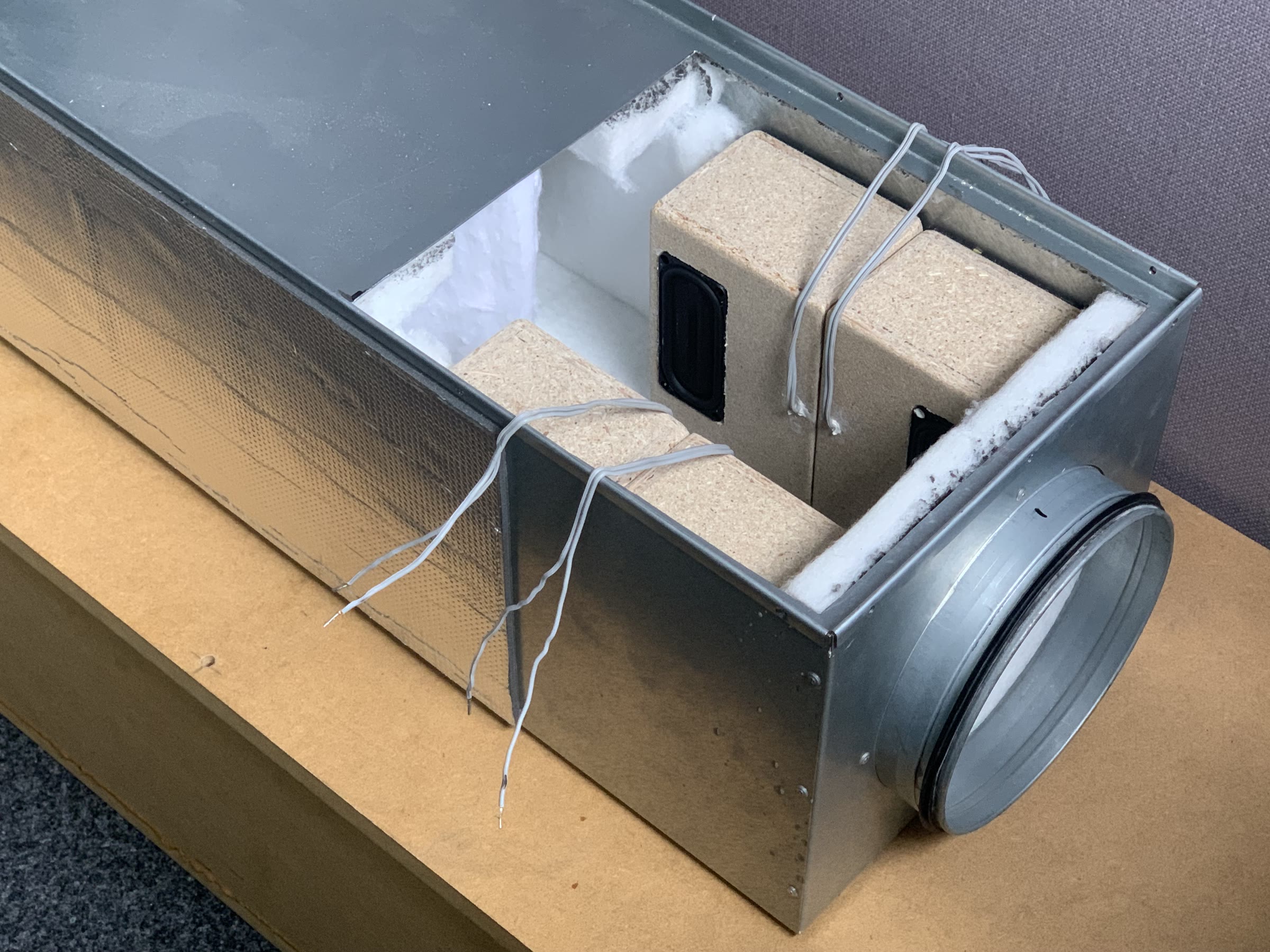
Despite the configurable standard controller, a complete ANC system is not available off the shelf. Tell us what you hear, under which operating conditions it occurs and where attenuation is required. We will discuss the most useful first step.
If measurement or testing shows that ANC is not the most economical route, the results remain useful: they guide targeted changes to the source, mountings or sound path, or the design of a silencer or noise-control cabin.